Adding Cords
|
| |
|
| |
| Adding cords in the body of a project is a Macrame technique seldom described in books devoted to this craft. For someone with experience, increasing the number of cords at any point in the pattern is no problem at all. But a beginner might find these important techniques a challenge, which is why I am addressing the topic. |
| |
The terms Mount and Hitch mean to attach one cord to another one, or to a ring, dowel, or similar object. So the first step in most Macrame projects is called the Mounting Process. You will start with a certain number of cords to begin knotting.
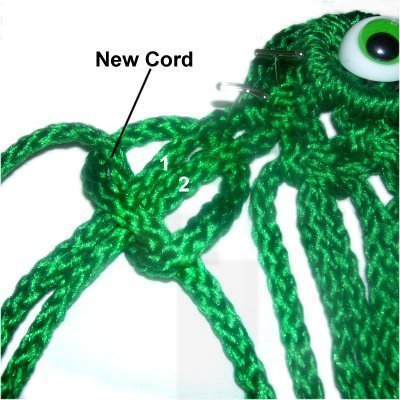
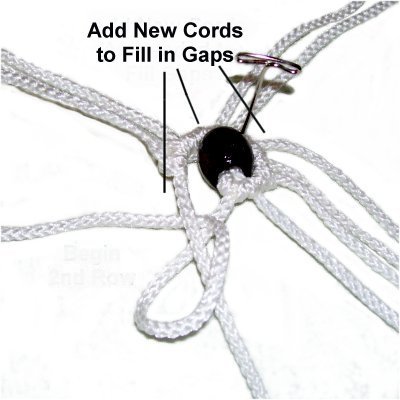
The term Adding Cords means to attach extra strands somewhere in the overall design, after the mounting stage. There are several ways that this is accomplished:
- Add Cords to an Object (such as a ring)
- Attach Cords to Existing Strands
- Add the new cords beside other strands
- Adding cords without knotting them
- What to do if you run out of material
All these techniques are described on this page, so be sure to read to the end. This is an IMPORTANT part of learning Macrame, so be sure to study and practice these techniques.
You can click on the small images and new photos will show up in a new window. |
| |
| |
ADD CORDS TO AN OBJECT |
| |
You may be asked to attach the cords to something, such as a ring or a dowel, in the body of the pattern. Adding cords is easy in that case. Mount the extra strands to the object, beside or between the other strands you’ve been working with.
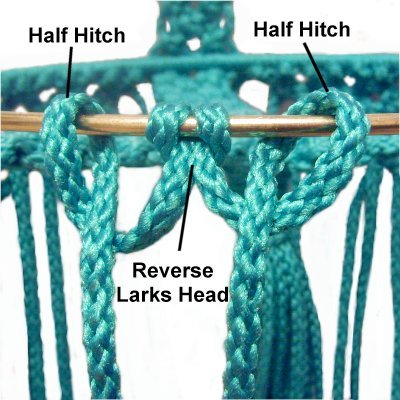
Larks Head knots and Double Half Hitches are the most common knots used for this type of addition. Keep in mind the fact that you usually need to tie the knots differently in the body of a Macramé project as compared to the mounting process. |
| |
| |
| |
 |
|
Say for example the pattern calls for mounting new cords to a ring, somewhere in the middle of the design. The original cords are attached to that ring with Double Half Hitches. The new cords can be attached with the DHH Mount. It’s the same knot, but the process is slightly different because the cord you add is not already attached to something. |
|
|
| |
| To finish it off, the tail at the top would be weaved into the overall pattern, or used to make other knots. |
| |
| |
| |
 |
|
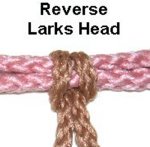
You may be asked to use a REVERSE Larks Head knot instead, which resembles the two loops of a Double Half Hitch.
This is the most common knot used for adding cords next to Double Half Hitches, so be sure you know how to tie it in both directions. |
|
|
| |
| |
| |
 |
| |
ATTACHING CORDS TO EXISTING STRANDS |
| |
| Many patterns require you to add more cords to make the design wider. Usually the patterns will tell you exactly where to attach the new strands, and which decorative knot to use. But sometimes the pattern doesn’t give you clear details, so here a few tips: |
| |
| |
| |
| |
 |
|
Tip #1: Try to match the knots used when adding new strands to the other ones in the area. They need to blend in. This is especially important if you are adding more than 2 cords. Every knot you tie changes the design, even if it’s a very small knot. |
|
|
| |
| |
| |
 |
|
Tip #2: Many Macrame patterns require you to add more than one strand, so the pattern is symmetrical. See how this Collar Choker is the same on both sides? That's called SYMMETRY. |
|
|
| |
| |
Look carefully at the photo or drawing of the item you are making. More often than not, it will be equal on either the sides, or the upper and lower areas.
When adding cords, you must take this into account. Be prepared to add cords in more than one area, even if the pattern is not specific.
I can’t tell you how many times I forgot this principal, and ended up with lopsided patterns. Once you are finished, it’s usually too late to remedy a mistake. |
| |
| |
ADDING CORDS WITH A SQUARE KNOT |
| |
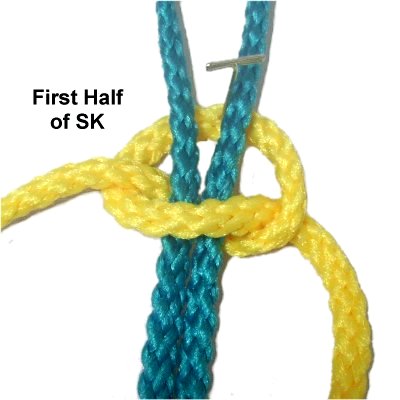
| The most common decorative knot used for adding cords to existing strands is the Square Knot. The new cord you add will be the working cord. The existing strand is the filler. Here are the instructions: |
| |
| |
| |
 |
|
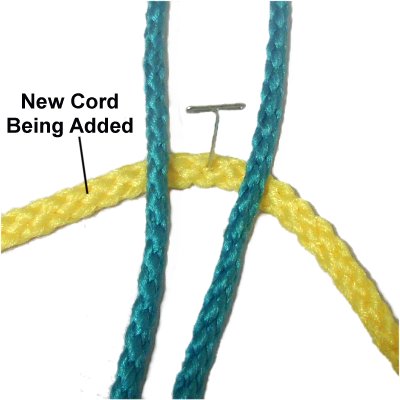
Step 1: Slide the new cord under 1 or more of the strands already being used, and center it. The instructions will usually tell you which cords will hold the new one.
In this image, the cord is being added to one ribbon (blue). |
|
|
| |
| |
| |
 |
|
Step 2: Use the new strand to tie the first half of the Square Knot.
|
|
|
| |
| |
| |
 |
|
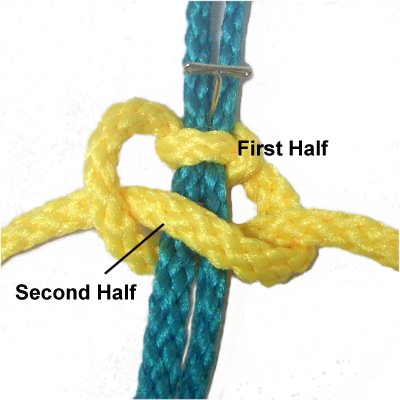
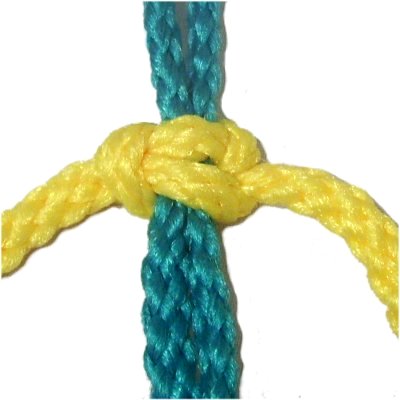
Step 3: Tie the second half of the knot. Tighten both parts so there is no slack at all above or behind the knot. |
|
|
| |
 |
| |
ADDING CORDS BESIDE OTHER STRANDS |
| |
| Another technique I’ve seen used in Macrame patterns is to add cords beside existing knots. Here’s how it works: |
| |
| |
 |
|
Fold the new cord in half, and place it next to one of the knots in the area. |
|
|
| |
| |
| |
 |
|
Use both ends of the new cord, along with one or two strands already in use, and tie whatever knot the pattern calls for. In this case, a Square Knot was tied. To get rid of the loops above the knot, pull on the ends of the new cord. |
|
|
| |
| |
 |
| |
ADDING CORDS WITHOUT KNOTTING THEM |
| |
| A very common way to add new cords is to do so without any knots. You simply wrap a new cord around an existing one, and as you tie additional knots, the new one is "captured". |
| |
| |
 |
|
In this image, the red cord was placed around one of the working cords used to make a purse strap.
When the next Square Knot was tied for the strap, the new one was held in place. |
|
|
| |
| |
 |
| |
WHAT TO DO IF YOU RUN OUT OF MATERIAL |
| |
OH NO, I cut the cords too short! It does happen, particularly if you are new to Macrame. This situation can also happen if you suddenly decide to change the pattern halfway through the project. Anytime you make changes, increasing the length or width, you could run out of material. Luckily, it’s not all that difficult to remedy the problem.
The easiest way of adding cords in this situation is to attach the new ones somewhere in the vicinity of the strands that are too short. The last two methods shown above will usually work.
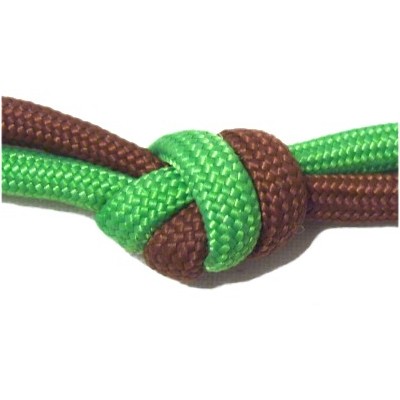
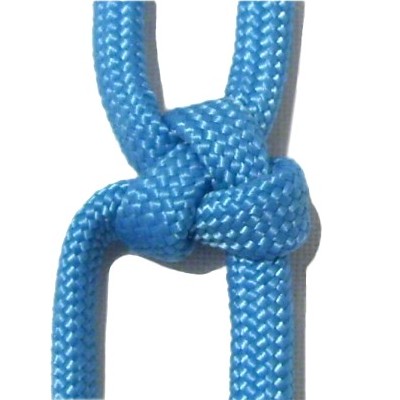
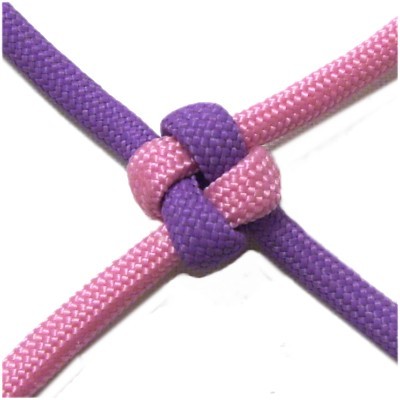
Sometimes it's better if you just add a new cord onto an existing one. But you have to keep in mind that the knot you choose to link them together has to blend in to the oveall design. The decorative knot also has to be one that is tied with two strands. Here are some options: |
| |
| |
| |
 |
|
Sailor's Knot: This is a flat knot, easy to blend into most patterns. It can be tied loosely, or all the way, and is made with two separate strands.
Click on the image to view the instructions. |
|
|
| |
| |
| |
 |
|
Shake Hands Bend: This is a type of Linked Overhand Knot. It's flat appearance is a real asset if you need a small knot that's easy to tie.
Click on the image to view the instructions for this and other Linked Overhand Knots. |
|
|
| |
| |
| |
 |
|
Triangle Knot: This vintage knot is rarely seen anymore, but it's very easy to tie and blends in quite well to most patterns.
Click on the image to see the instructions for this unique knot. |
|
|
| |
| |
| |
 |
|
Diamond Stitch: This is another unique Vintage knot that can be used to link two cords.
Click on the image to view the instructions. You need to use the two-strand Diamond Stitch rather than the Cross Knot, which is made with only one cord. |
|
|
| |
| |
| |
| |
 |
|
Fisherman's Knot: This is a type of Figure Eight design that is great for adding a new cord to an existing one.
Click on the image to view the instructions. |
|
|
| |
| |
| |
 |
| |
| |
| |
 |
|
101 Easy Craft Project Ideas
Create personalized unique crafts even if you never made a thing with your hands. Use these easy to follow step-by-step craft ideas.
Find projects for all ages and abilities. |
|
|
| |
 |
| |
| |
Build a Ship in a Bottle
Learn the ancient Mariner's art of building ships inside bottles with this unique E-Book. |
|
 |
|
|
| |
 |
| |