Free-Macrame-Patterns.com Logo
Free Macrame' Patterns Home Page
Macrame' Essentials
Learn Macrame' Knots
Micro-Macrame': Jewelry
Free Macrame' Patterns
Macrame' for Kids
Macrame' Dictionary
Contact Free-Macrame-Patterns.com
Free-Macrame-Patterns.com Left Side Background Image
 

Macrame Dictionary

 
Macrame Spiral Picot

Spiral Picot


Do you know what a spiral picot is? This Macrame Dictionary will help you learn the different terms and abbreviations used in this craft. You may need to look up the definitions for some of the terms in the free patterns in this site, particularly if you are new to this craft.

Alternate: This term refers to the process of passing cords under and over others to weave a design. See Interlocking Weave for an example of the use of this definition.

Alternating: Patterns where the number of knots changes back and forth with each new row. See Alternating Square Knots.

Amount: You’ll see this term used in instructions for larger projects. It refers to how much cord you need to obtain for the entire project. The amount will be indicated in yards.

Bar: Tying a series of knots that form a distinct, raised area in the pattern. They are described as horizontal, diagonal, or vertical. See Double Half Hitch, for details.

BH = Buttonhole

Body: Refers to the main section of the work, rather than the mounting or finishing steps.

Braid: This term is generally used to refer to a type of cord made by braiding individual strands together in the manufacturing process. It is also used to mean the same as Plait.

Button: Refers to either a specific type of round knot, or the molded buttons used in clasps and for decorations. See also Shank, further along in this Macrame Dictionary.

Celtic: The artistic patterns that originated in Europe, particularly Wales, Ireland and Scotland.

CH = Chain

Chain: Tying a series of knots one right after the other. Also called a Sennit. The term Band is sometimes used, particularly if the knots form a unique pattern. See Alternating Half Hitch,for an interesting chain pattern.

Coil: This term is used to describe individual portions of the cords that you go over and/or under when tying the knot.

Composition: A term that relates to what fiber(s) the cords are made from.

Cord: The material you use to tie Macrame knots, such as leather, nylon, cotton, hemp, silk, yarn, or ribbon.

Core: This term is used to describe a specific strand that holds the knot. The working cord makes the knot around it. Also referred to as a filler cord. See Basket Stitch for an example.

DBL = Double

Diagonal: A cord, or row of knots, that runs from upper right to lower left, or upper left to lower right.

Diameter: The width of a strand of cord, described in millimeters.

DHH = Double half hitch

Filler Cords: The cords that you tie the knots around. For example, if you are using 4 cords to make a Square Knot, the inner two are filler cords. Also referred to as the Core.

Findings: Fasteners or closures for necklaces, bracelets, and earrings. They are usually made from some type of metal. See Jewelry Fasteners for photos and more details.

Finishing knot: Used primarily at the ends of the cords to secure them, and prevent unraveling.

Fold: This term refers to loops that are narrow and/or elongated.

Fringe: A decorative feature that results in a large group of dangling cords. Tassels, a related technique, are described further along in this Macrame Dictionary.

Hemp: A tough, coarse fiber that you can use to make Macrame projects. Popular in the 1960’s, it was made from the same plant as marijuana.

Holding Cord: The specific cord that the knots are attached or mounted to. See Double Half Hitch for an example of this term.

Horizontal: A cord, or row of knots, that runs side to side within your Macrame project, parallel to the floor.

Interlace: A pattern where you intertwine and weave the cords together. See also Weave, furhter along in this Macrame Dictionary.

Jute: A strong, coarse fiber that you can use for Macrame projects, particularly suited to making outdoor furnishings. Burlap sacks are made from this material.

K = Knot

Length: This term is used in reference to cutting the individual strands to specific measurements. In this site, the length of the cords will be described in inches.

Loop: A circular or oval shape usually made by overlapping two ends.

Macrame: The craft of tying knots in cords in a variety of patterns to form artistic decorations, clothing, furniture, and jewelry.

Micro-Macrame: The craft of making Macrame projects using very delicate cords. Particularly suited to creating handcrafted jewelry.

Mount: The process of attaching cords to a ring, handle, frame, or another cord. See Lark’s Head Knot, which is commonly used in the mounting process.

Netting: A pattern of knots formed with open space between the knots. Used in hammocks, curtains, etc.

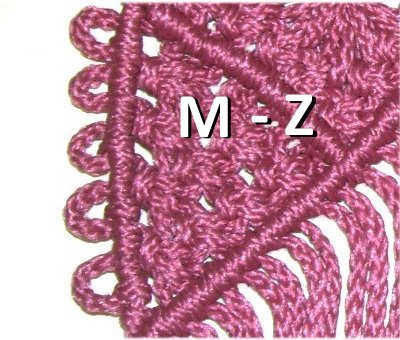
Picot: A loop of cord that stands out from the finished edge. See Chain Picot Mount.

Plait: Overlapping 3 or 4 cords in an alternating pattern. See Braid previously described in this Macrame Dictionary. Go to Interlaced Plaits for more details.

Scallop: A distinct loop of knots, created along the edges of crafted items. Refer to Scallops and Buttons Shawl, for photos and details on the use of this technique.

Sennit: See Chain, previously described in this Macrame Dictionary.

Shank: Refers to a type of button with a hole running through a tab in the back.

Spiral: This term is used to describe a chain of knots that will form a decorative twist as they are tied.

Stiffness: The degree a cord you are using will stretch or bend.

Stitch: This term is used to refer to specific types of patterns that knots can make. It is also used to describe knots that have names similar to others, such as Spiral Stitch.

Strand: Means the same as Cord, previously described in this Macrame Dictionary.

Strength: Refers to whether a particular material used will resist breakage.

SQ = Square

Symmetrical: When you tie the same knots on either side, or on the upper and lower portions, of the pattern you are making.

Tail: This term is used to refer to the unknotted end(s) of cords.

Tassel: A decoration consisting of a group of threads bound together with a knot, with the strands hanging loosely below. See Tassels for more details.

Tension: Referring to the tightness of the cords as they make the knot. The term is also used in relation to securing cords to a work surface.

Texture: A description of what the cords feel like (soft, rough, etc.).

Tightening: Adjusting the knotted cords in a specific way to move the coils closer together. It’s the most important step in many types of knots.

Triquetra: A Celtic art symbol representing “triples”: Body, Mind, and Spirit, the Triple Goddess, the Trinity, and Earth, Sea and Sky. See Celtic Triangle Knot.

Twist: This term relates to how the cord material is manufactured; whether it is braided or twisted as it is formed.

Vertical: A cord, or row of knots, that runs from top to bottom.

Vintage: A pattern, knot, or technique popular in the early 1900’s or before. See Venetian Picot Mount for a prime example of a Vintage technique.

Weave: Alternating over and under vertical and horizontal strands to create a pattern.

Working Cords: The cords used to tie the knots. Also referred to as knotting cords in some patterns.

Have any comments or suggestions about the Macrame Dictionary? Contact Me.


Free-Macrame-Patterns.com Footer

Website Directory

The Craft Directory - Arts and Crafts Search Directory

FreeWD.Org


Web Page Designed by Stasis Publishing AZ