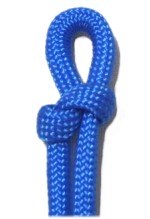
Slipknot
|
| |
| |
| |
 |
|
 |
|
 |
|
| |
Slipknot |
|
Alpine Butterfly |
|
Ashoka Chakra |
|
|
| |
| |
Description:
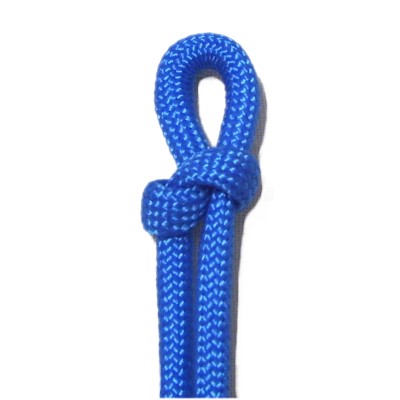
The Slipknot is sometimes called the Overhand Noose. It’s been
used for many centuries, but for practical purposes rather
than as a decorative knot. It’s one of several "connection
knots" used in Macrame, and can be used in the mounting process as well.
Variations: Below are instructions for a similar technique, called the Alpine Butterfly Knot. The knot produces a stable loop, rather than an adjustable one.
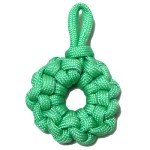
I've also included instructions for a very unique application of this decorative knot. It's called the Ashoka Chakra knot, and it forms a decorative ring.
Click on the icons to see larger images, which come up in a new window. |
| |
| |
| |
| |
|
|
Step
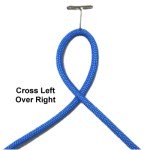
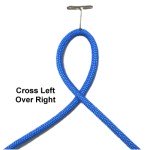
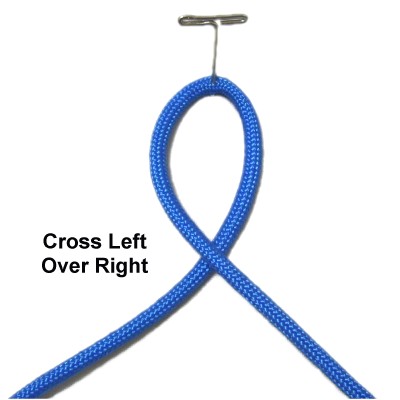
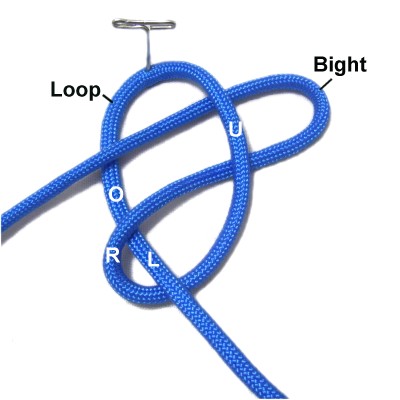
1: Make a clockwise loop with a piece of cord material. The working end should be on the left when you are finished. Secure the end on the right.
Some patterns will tell you precisely where to place the loop along the cord, and which end is the working portion.
|
|
| |
| |
| |
 |
|
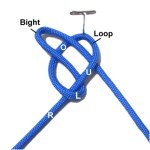
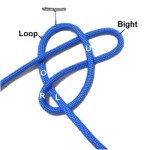
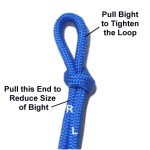
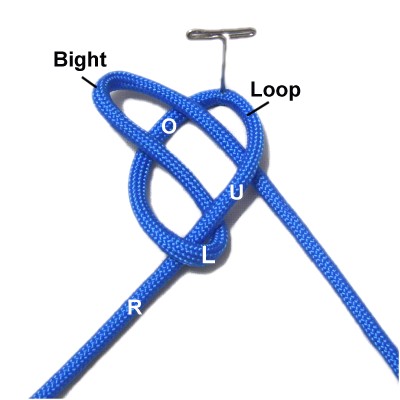
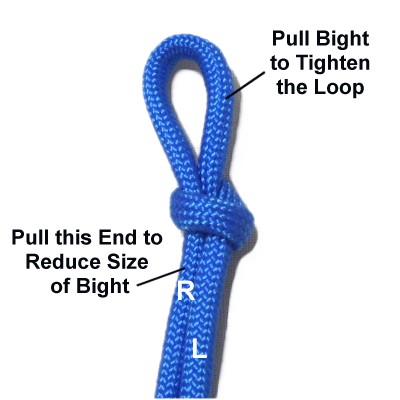
Step 2: Make a bight with the working end. Push it through the center of the first loop, from below (under-over).
Tighten the loop by pulling on the bight. To adjust the size of the bight, pull on the working end. |
|
| |
| |
| |
 |
|
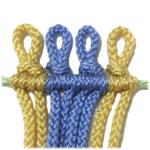
Design Tip: In this Unique Mounting Design, I used a Slipknot as a picot loop. It's attached to a holding cord, and can be mounted to a dowel or ring as well. |
|
|
| |
| |
 |
| |
Alpine Butterfly Knot |
| |
| |
|
| |
The Alpine Butterfly knot is related to the Slipknot, but is constructed differently. The knot below the loop is triangular in shape.
This is a good technique to produce a stable loop, rather than a loose one. This variation can be used for plant hangers, bell pulls, or
even curtains. It can also be used to mount cords to a ring,
dowel, or similar item. |
| |
| |
| |
 |
|
Step 1: Obtain one strand of material, at least 36 inches in length.
Secure one end to your work surface. Tie an Overhand knot near one end, and secure it to your board. This is Loop 1.
The crossing point
needs to be on the left, with the working end at the top as shown. Do Not tighten the knot. |
|
|
| |
| |
| |
 |
|
Step 2: Use the working end of the cord, and bring it down, passing through the Overhand Knot from above (over - under).
The working end should rest to the right of the secured end. This is Loop 2. |
|
|
| |
| |
| |
 |
|
Step 3: Direct the working end in a clockwise direction, to make the third loop. Pass over the secured end of the cord, at the bottom of the Slipknot.
Next, bring the end up to the top, and under the second loop. |
|
|
| |
| |
| |
 |
|
Step 4: Bring
the working end down and into Loop 1.
Make sure it rests to the right of the segment of Loop 2 that runs through it. |
|
|
| |
| |
| |
 |
|
Step 5: To tighten this variation of the Slipknot, first pull on Loop 2 to adjust Loop 1, which is the center of the knot. |
|
|
| |
| |
| |
 |
|
Step 6: Adjust the size of Loop 2, by pulling on the third loop, which is on the left.
Loop 2 is supposed to be left a little loose. The other two loops are tightened completely. |
|
|
| |
| |
| |
 |
|
Step 6: Tighten Loop 3 by pulling on the working end, which is on the right.
Now you can see the triangular shape of the knot below the the loop. |
|
|
| |
| |
| |
 |
| |
Ashoka Chakra Knot |
| |
| |
 |
| |
| |
Description: The Ashoka Chakra knot is made using only the Slipknot. It's great for making earrings, pendants, and frames for stones, buttons and beads. |
| |
| |
| |
 |
|
I found this unique decorative knot in J.D. Lenzen's website, called Fusion Knots.
Be sure to visit his website, by clicking on the link or image. His knot library contains video tutorials for a variety of very interesting knotting techniques. He also has this book available, if you want one for your own reference. |
|
|
| |
| |
| |
| |
 |
|
Step 1: Make a counter-clockwise loop approximately 3 inches from one end of a 36 inch cord.
Make sure the working end passes over the tail to form the crossing point. |
|
|
| |
| |
| |

 |

|
Step 2: Make a bight with the working end.
Push it through the loop, from below, heading left to right. Tighten the knot by pulling on the bight. |
|
|
| |
| |
| |
 |
|
Step 3: Adjust the size of this first knot by pulling on the ends.
The length of this loop determines the size of the Ashoka Chakra Knot (see below). |
|
|
| |
| |
Here's how to figure out the size you need to make Loop 2: Multiply the size you need by 2, then add an inch for the loop at the top, if you need it.
- 3-inch Loop = Earring Size (1.5-inch diameter)
- 5-inch Loop = Pendant Szie (2.5-inch diameter)
- 7-inch Loop = Ring for Plant Hangers (3.5-inch diameter)
|
| |
| |
| |
 |
|
Step 4: Make a counter-clockwise loop with the working end to make a second slipknot. Pass the end under to make the crossing point on the left. |
|
|
| |
| |
| |
 |
|
Step 5: Make a bight with the working end, passing it into the loop from the top. Keep the working end at the bottom as you tighten the knot by pulling on the bight.
There should be a small amount of space between the two knots. |
|
|
| |
| |
| |
 |
|
Design Tip
By adding more space between the knots, picot loops will form. |
|
 |
|
|
| |
| |
| |
 |
|
Step 6: Take the first Slipknot, which is the long one, and direct it through the second one from the top (over - under).
Keep the working end to your left. Tighten the second knot by pulling on the end. |
|
|
| |
| |
| |
 |
|
Step 7: Make the next Slipknot, just as you did in step 4 - 5.
Direct the first knot through the new one, as in step 6. |
|
|
| |
| |
| |
 |
|
Step 8: When you have made enough knots to cover most of Loop 1, turn the Ashoka Chakra knot so the tail is at the top.
Tie the last Slipknot with the working end, around Loop 1, as you normally would. But don't tighten it yet. |
|
|
| |
| |
| |
 |
|
Step 9: Pass the TAIL through both loops, to create the circular design. Pull on the working end to tighten the last slipknot. |
|
|
| |
| |
| |
 |
|
The remaining portion of Loop 1 can be used to hang the design from a necklace. If you prefer, you can direct it into the spaces in the back, as you would do the ends to finish them off.
Applying glue to the last Slipknot will ensure that the design remains circular. |
|
|
| |
| |
| |
 |
| |
 |
| |
 |
| |
| |